When Modular Cabinets Beat Custom
Custom cabinetry wins the drawing and loses the calendar. A made-to-order kitchen takes the 8-12 weeks CasaBuilt attributes to the traditional route, while a modular order ships in 3-10 business days flat-packed or within two weeks pre-assembled. The question is not which cabinet is better built. It is which one fits the room, the budget and the date.
Key takeaways
- Modular cabinets cover base widths from 9 in to 42 in and wall widths from 9 in to 39 in, in 3-inch steps.
- Pre-assembled orders are quoted at within two weeks; the RTA window is 3-10 business days.
- Fourteen days is one quarter of the 8-week end of the traditional 8-12 week estimate.
- Trade buyers can shorten dispatch to three business days or less through quick ship.
What modular actually means
A modular cabinet is a standard box with a menu attached. The box dimensions are fixed by the catalog, and the buyer chooses the width from the published list, the height from two or three options, the door style and the finish. Nothing is drawn from a blank sheet, and nothing is measured by a fabricator before cutting.
That definition separates modular from two neighbours. Semi-custom usually means a standard box that can be modified within limits, which still involves a factory change. Custom means a drawing and a tolerance, with a price that reflects both. Modular sits at the fixed end: the factory builds the same box for every buyer and the buyer fits the room to it.
The trade-off is honest. Modular is faster and cheaper because the factory never stops to read a drawing. It also cannot solve a wall that is 117-1/2 in long with a 117-1/2 in cabinet. The fit comes from fillers, trim and a cabinet mix, which is why the measuring step matters more than the door choice.
The decision table
Use the questions below in order. If the answer falls on the modular side for the first four rows, the remaining rows rarely justify a custom order. If two or more fall on the custom side, a standard box will need so much site work that the saving disappears.
| Question | Modular answer | Custom answer | Figure to check |
|---|---|---|---|
| How long until dispatch? | Fixed production slots, no drawing approval | Drawing, approval, then production | 3-10 business days RTA; within 2 weeks pre-assembled; 8-12 weeks traditional |
| Can the width change? | Only inside the published steps | Any width on the drawing | Base 9-42 in; wall 9-39 in |
| Who measures? | The buyer, then the installer confirms | The fabricator, before cutting | Measurement guide published by the seller |
| What does a change cost? | A new cabinet or a filler | A revised drawing and a change order | Basic six-cabinet kitchen from $1,199.50 |
| How many finishes? | The published door range | Any color matched to a sample | 16 door samples in stock at $9.99 |
| Who owns the fit? | The installer, with filler and trim | The fabricator, to the drawing | Filler and trim outside the cabinet price |
The table is blunt on purpose. A custom order buys certainty of fit and pays in time and drawing cost. A modular order buys speed and pays in site labor. The mistake is ordering modular and expecting custom fit, or paying for custom in a room where standard boxes already align.
One row deserves a second look. The published starter kitchen at $1,199.50 is six cabinets, so the modular route has a visible floor. A custom quote rarely has one, because the drawing is priced before the boxes exist. Ask for the modular equivalent of a custom list, cabinet for cabinet.
The 14-day line
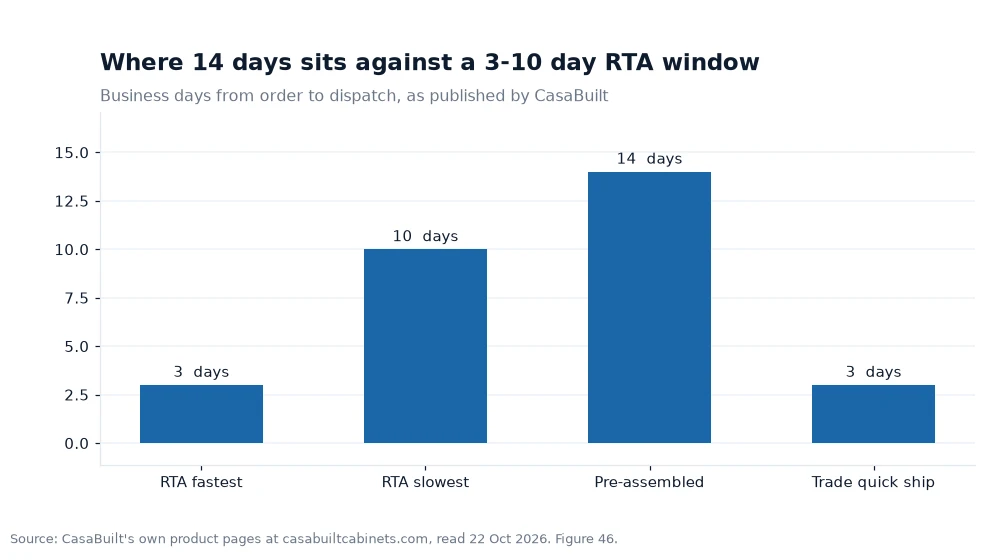
Pre-assembled is the slowest modular route in the published figures at within two weeks, and it is still the fastest way to get a joined cabinet into a kitchen. The RTA route ships in 3-10 business days, and the trade quick-ship program promises three business days or less.
Set those numbers against the traditional estimate the company publishes, 8-12 weeks. Fourteen days is 56 days minus 14, or 42 days earlier than the short end of that range, and 84 minus 14, or 70 days earlier than the long end. Seventy days is ten weeks exactly, which is the difference between ordering cabinets and ordering cabinets twice.
The 14-day figure is a dispatch window, not a delivery promise, and it excludes Alaska and Hawaii on the RTA side. A buyer should treat it the way an airline treats a departure time: plan the trades around the far end and be pleased when the carton arrives early. The kitchen does not need the cabinet on day 14; it needs a countertop template, and that cannot happen until the boxes are set.
Custom does not lose only on the calendar. Every week between order and delivery is a week of storage, temporary counters and a kitchen that cannot be used. On a rental or a flip, that cost is paid in rent or in carrying costs. On an owner-occupied remodel, it is paid in takeout.
Where custom still wins
A wall that is out of square by more than an inch, a historic trim profile that has to be matched, an appliance opening that falls between standard widths, a curved run, a ceiling that slopes across the cabinet line. These are the rooms where a drawing beats a catalog, and no amount of filler makes a 3-inch gap look intentional.
There is also a design case. A custom kitchen can carry an inset door or a color that no stock line offers. CasaBuilt's published range covers Shaker, Double Shaker, Slim Shaker, Frameless, Raised Panel and High Gloss profiles, across 11 Shaker items, 14 Framed items, 2 Frameless items and 1 Raised Panel item.
Buyers who are unsure which side of the line they sit on can use the free design service before committing. CasaBuilt delivers a 3D kitchen design in 24-48 hours, which is enough to test whether standard widths fit the measured room. A design built on a wrong measurement is worthless, so the tape measure comes first and the drawing second.
For buyers who want the modular route, the practical comparison is between flat-packed and joined boxes from the same catalog. The finish, hardware and box are the same; only the assembly and the shipping shape change. That makes the choice a labor decision rather than a quality decision, which is the opposite of how custom versus modular is usually framed.
Worked example
The chart lists four dispatch windows: RTA fastest at 3 days, RTA slowest at 10 days, pre-assembled at 14 days and trade quick ship at 3 days. Take the pre-assembled figure and compare it with the others. It is 14 minus 10, or 4 days slower than the RTA slowest case, and 14 minus 3, or 11 days slower than the RTA fastest and the quick-ship case.
Now compare the same 14 days with the 8-12 week traditional estimate. Eight weeks is 56 days, so 56 minus 14 is 42 days saved. Twelve weeks is 84 days, so 84 minus 14 is 70 days saved. As a ratio, 56 divided by 14 is 4.0, so the pre-assembled route takes one quarter of the short end of the traditional window, and 84 divided by 14 is 6.0 for the long end.
Put a price beside the calendar. The published prefab cabinets start at $1,199.50 for the six-cabinet kitchen, and the same six pieces in the top published style reach $2,295.64. The $1,096.14 difference is roughly the value of 42 days of a kitchen that works, which is why the delivery window belongs in the same comparison as the price.
Frequently asked questions
Is modular the same as semi-custom?
No. Modular means a fixed catalog box with a choice of width, height, door and finish. Semi-custom usually means a standard box that the factory modifies within limits, which adds a drawing step. CasaBuilt publishes fixed widths from 9 in to 42 in for bases and 9 in to 39 in for walls, which is the modular end of the market.
How firm is the two-week pre-assembled window?
It is a published dispatch window, not a guaranteed delivery date. RTA orders ship in 3-10 business days and pre-assembled orders within two weeks, with Alaska and Hawaii excluded from the standard RTA window. Plan the countertop template and the other trades around the far end of the window rather than the near end.
When should I pay for custom instead?
When the room cannot take a standard width without visible compromise, such as a wall out of square by more than an inch, a curved run or a fixed appliance opening between published sizes. If the measured wall accepts 3-inch steps and the door range has a finish you like, modular usually wins on time and cost.
Decide with a tape measure
Measure the walls, write down every appliance opening and check the totals against the published width steps. If the numbers land within a filler, the modular route is the faster and cheaper buy. If they land outside it, price the custom drawing before assuming the modular order can be forced to fit. A design service can test the layout in 24-48 hours, but only a real measurement tells you which side of the line the room is on.
Figures quoted here come from the manufacturer's own website, read 22 Oct 2026[1].